- Sales & Growth
- In production, expanding
- Client work
Loop ERP: the CRM their sales team runs on, and the AI layer around it
Loop ERP sells enterprise software to the recycling and scrap industry. We replaced the generic CRM their sales team barely used with Noodle, a CRM shaped like their business, and kept building outward from it: Gmail and calendar sync, an SDR operating system, a live command center, and an AI layer that drafts, reads and files.
a production CRM in daily use by Loop ERP's sales team, with the surrounding systems graded honestly in the outcome: in production, built and rolling out, or in build. Screens are the real product on seeded, fictional data.
- Client
- Company
- Loop ERP
- Industry
- B2B Sales
A look inside
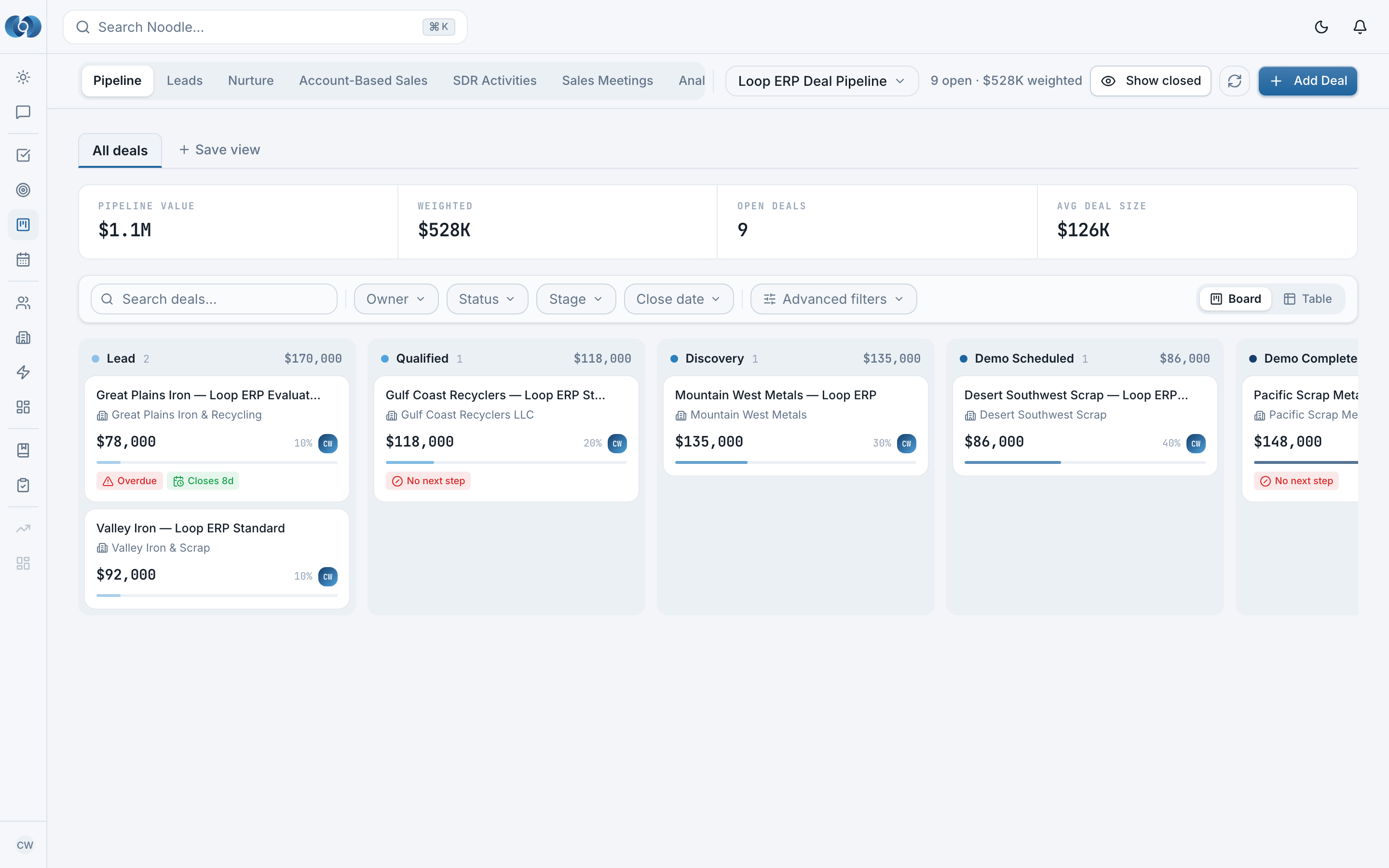
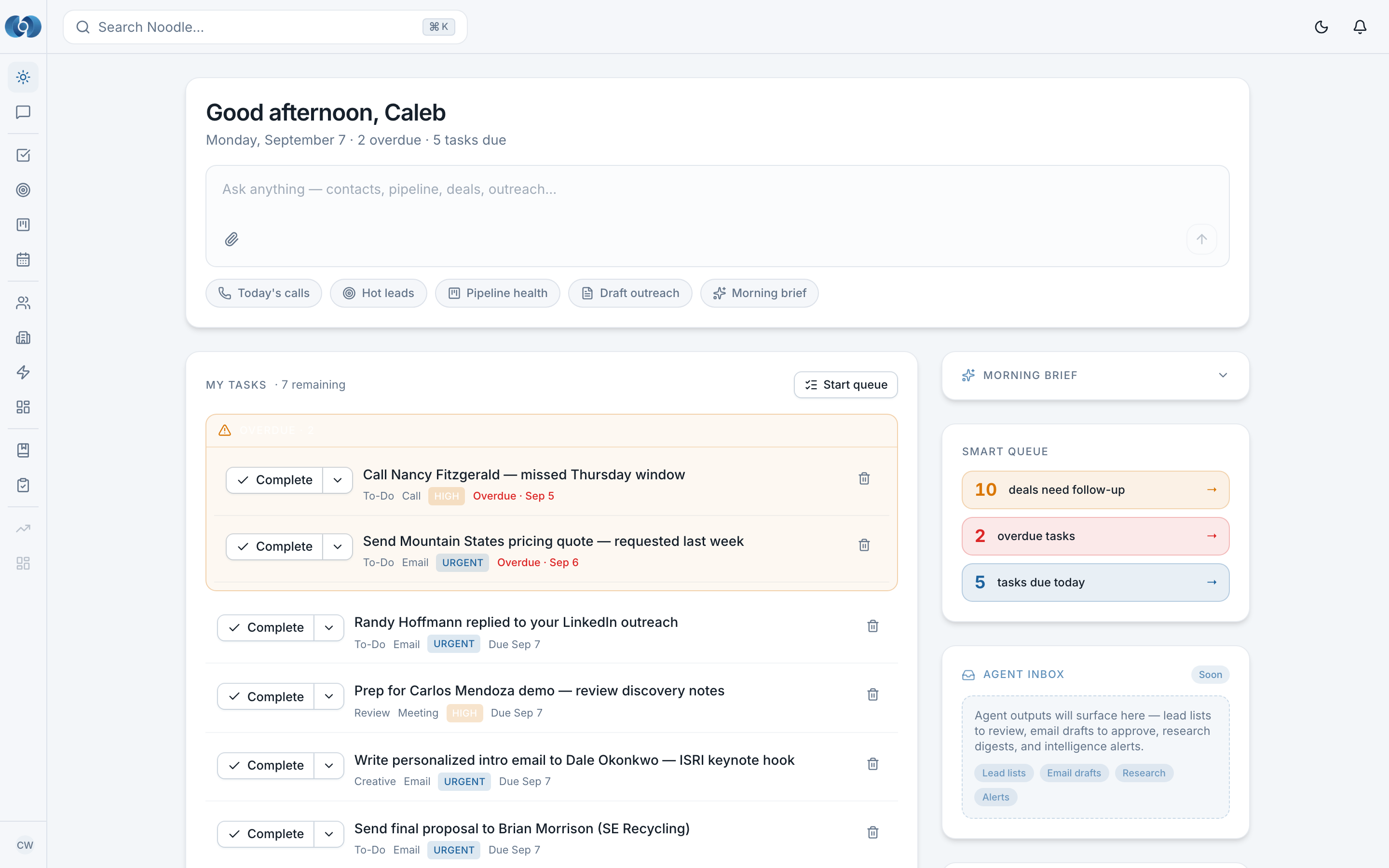
The day starts here: tasks, the smart queue, and the ask box over the whole CRM.
1 of 11
Three of them, close up
The pieces that are easiest to claim and hardest to show.
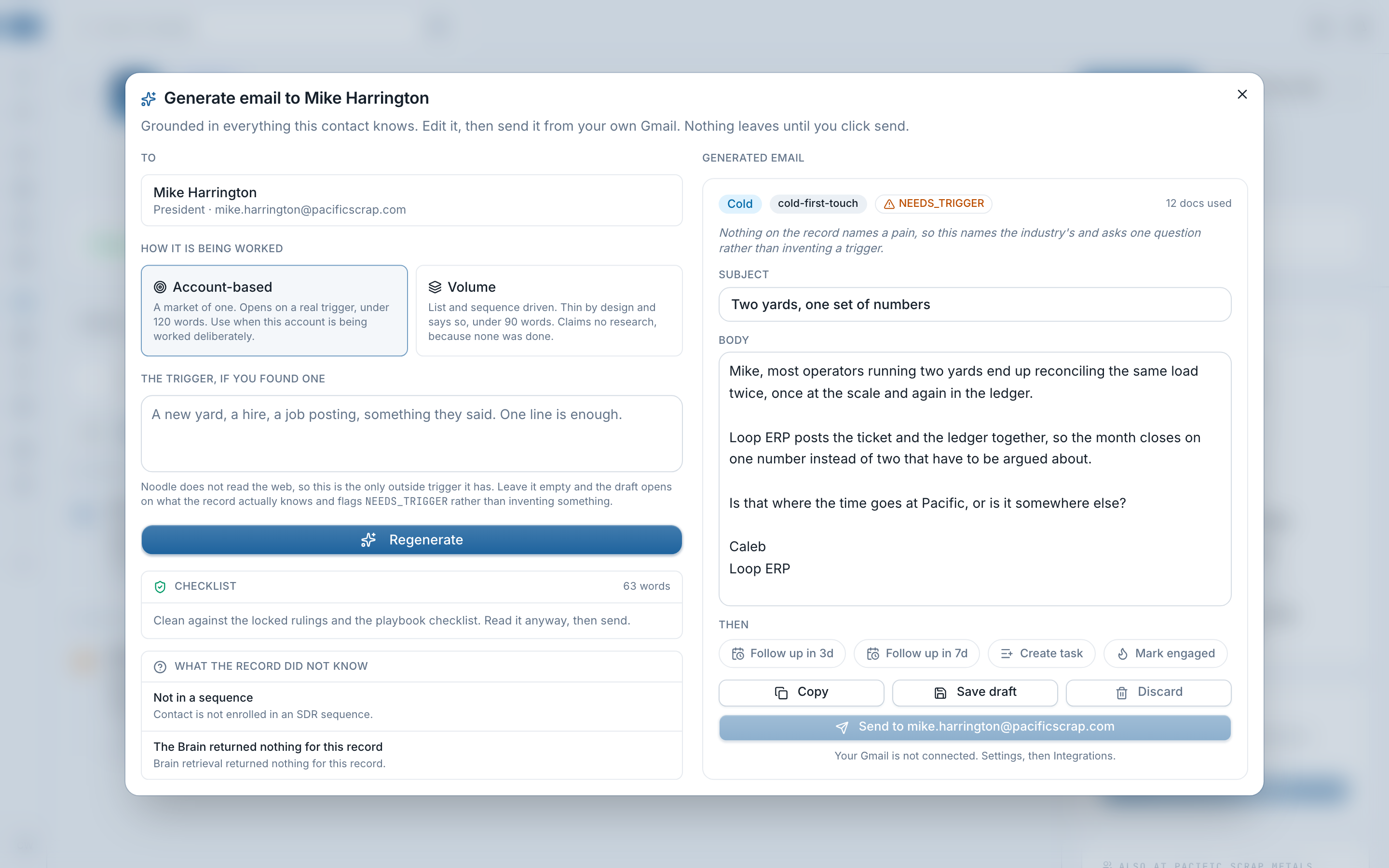
Email generation, on the record
A draft that says what it does not know.
One button on the contact, and the draft arrives with the record's own evidence behind it: how the account is being worked, whether a real trigger was found, the word count against the playbook's limit, and a list of what the record could not tell it. Nothing is sent until a person presses send, from their own Gmail.
The engine here is the real one, running through the product's own no-key sandbox mode: it built the prompt, validated the output against its own schema, counted the 63 words, raised the NEEDS_TRIGGER flag because no trigger was given, and worked out what the record was missing. The words in the draft were written by us rather than generated, and everything around them is the product computing.
Lead generation
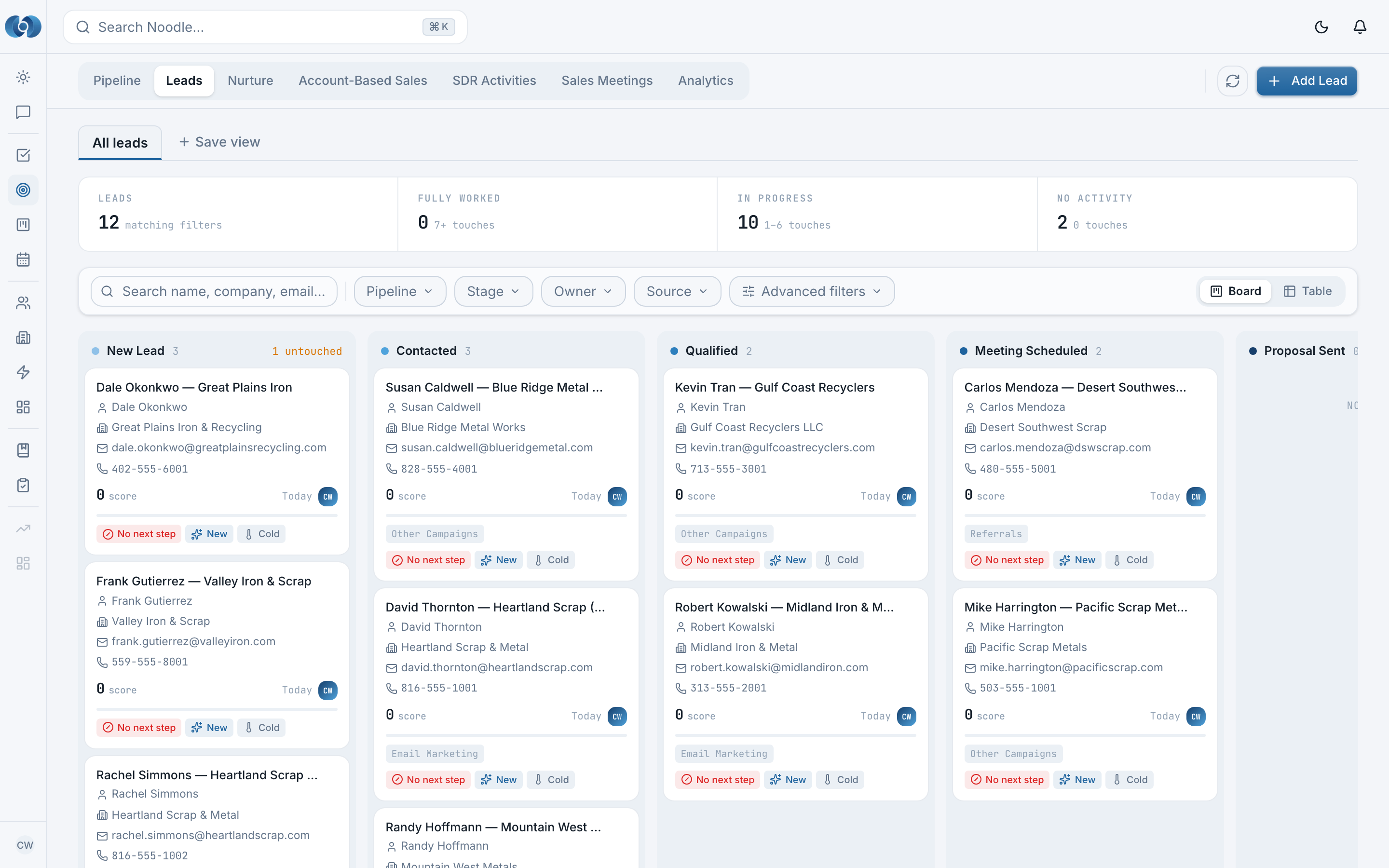
Every lead in one board, with the next move on its face.
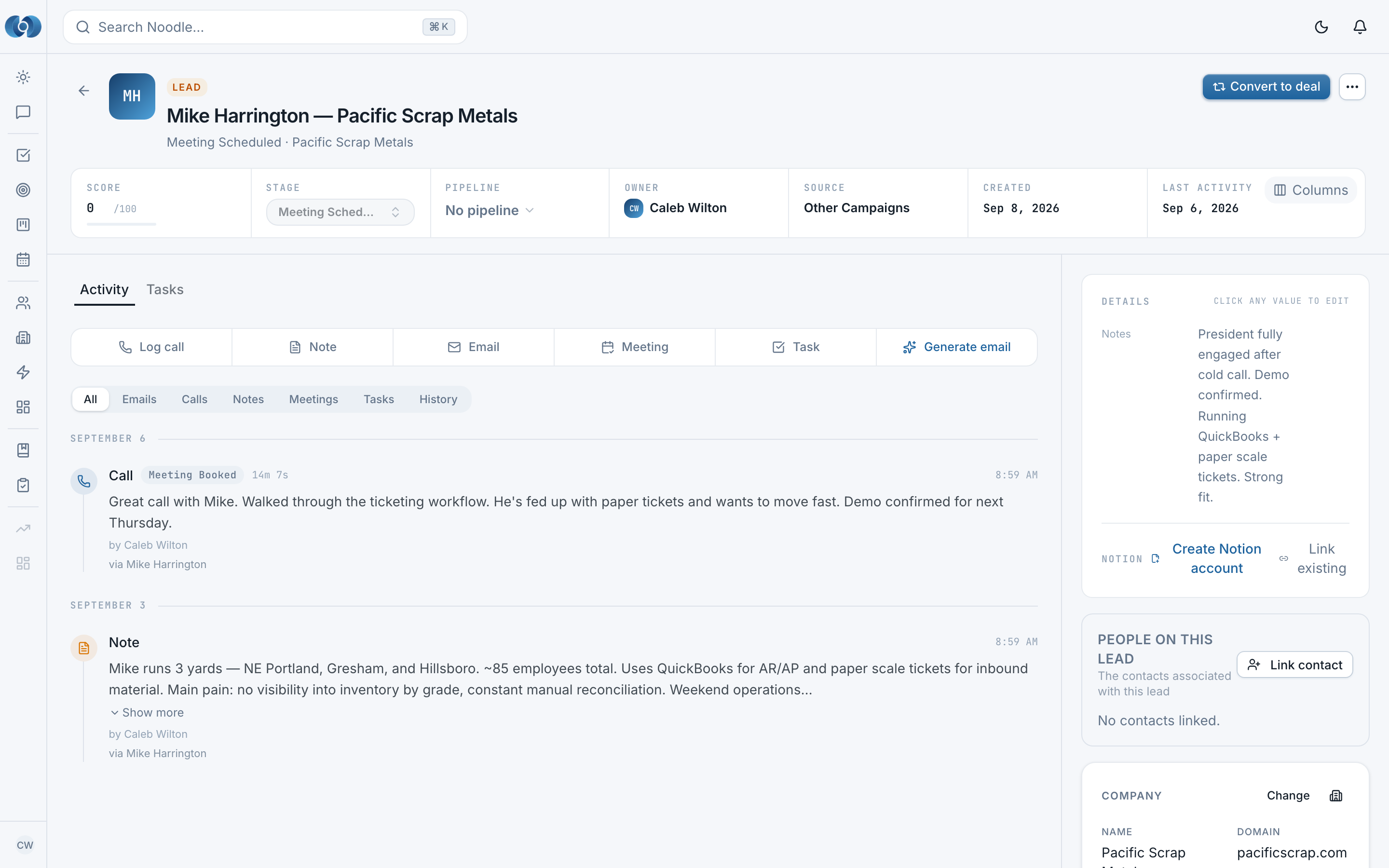
A lead arrives carrying where it came from and enters the board at New Lead. From there the rep works it: each card shows the company, the contact, how many attempts have gone in, whether there is a next step booked, and how warm it is. Nothing sits in a spreadsheet, and nothing is worked twice by accident.
The score column reads zero on purpose. Noodle's scoring and enrichment surfaces are still Coming Soon pages in the version shown here, so there is no engine behind that number yet and none is implied. The board, the stages, the attempt counters and the conversion are what shipped.
The chat, over the whole CRM
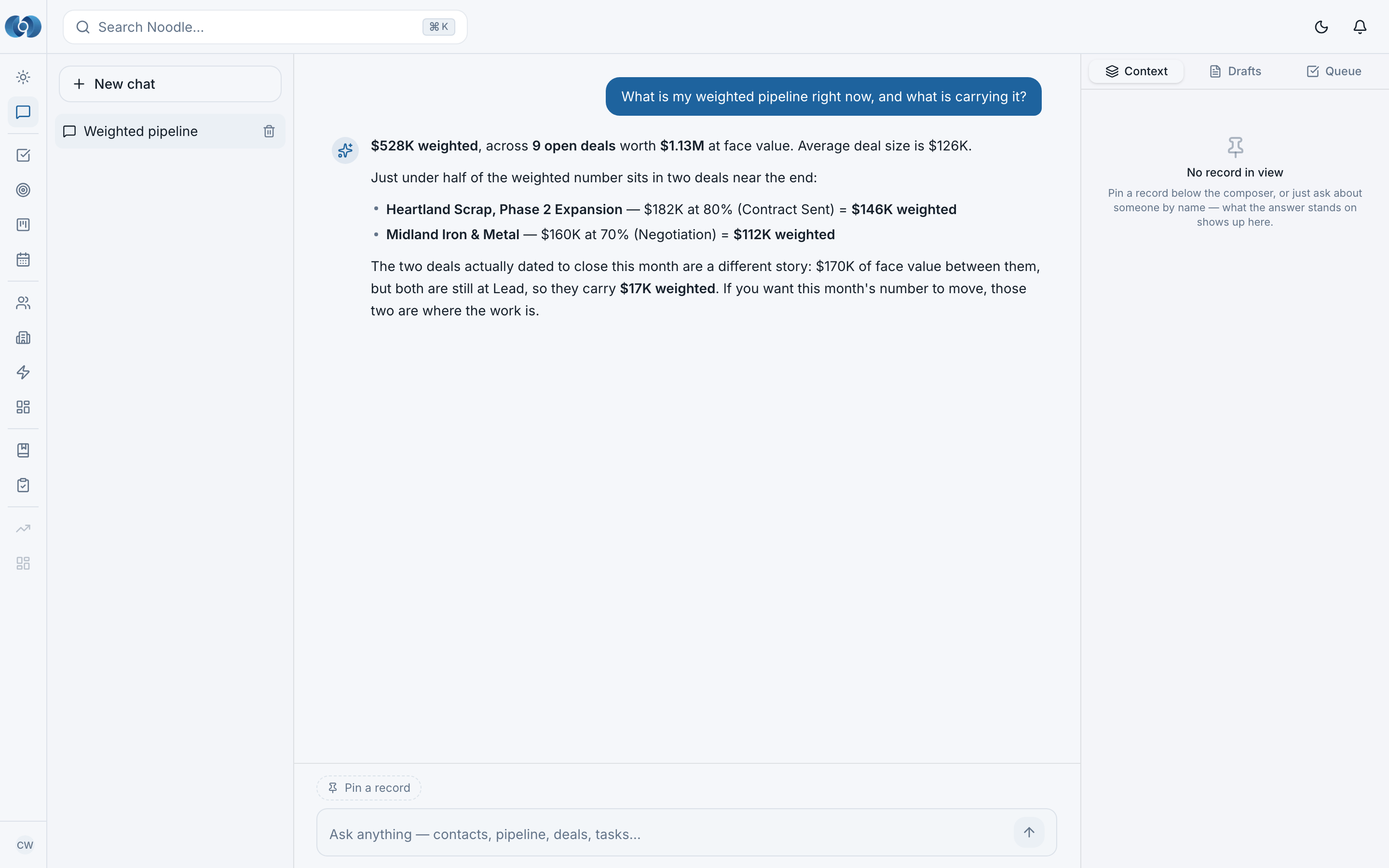
A question about the pipeline, answered in numbers.
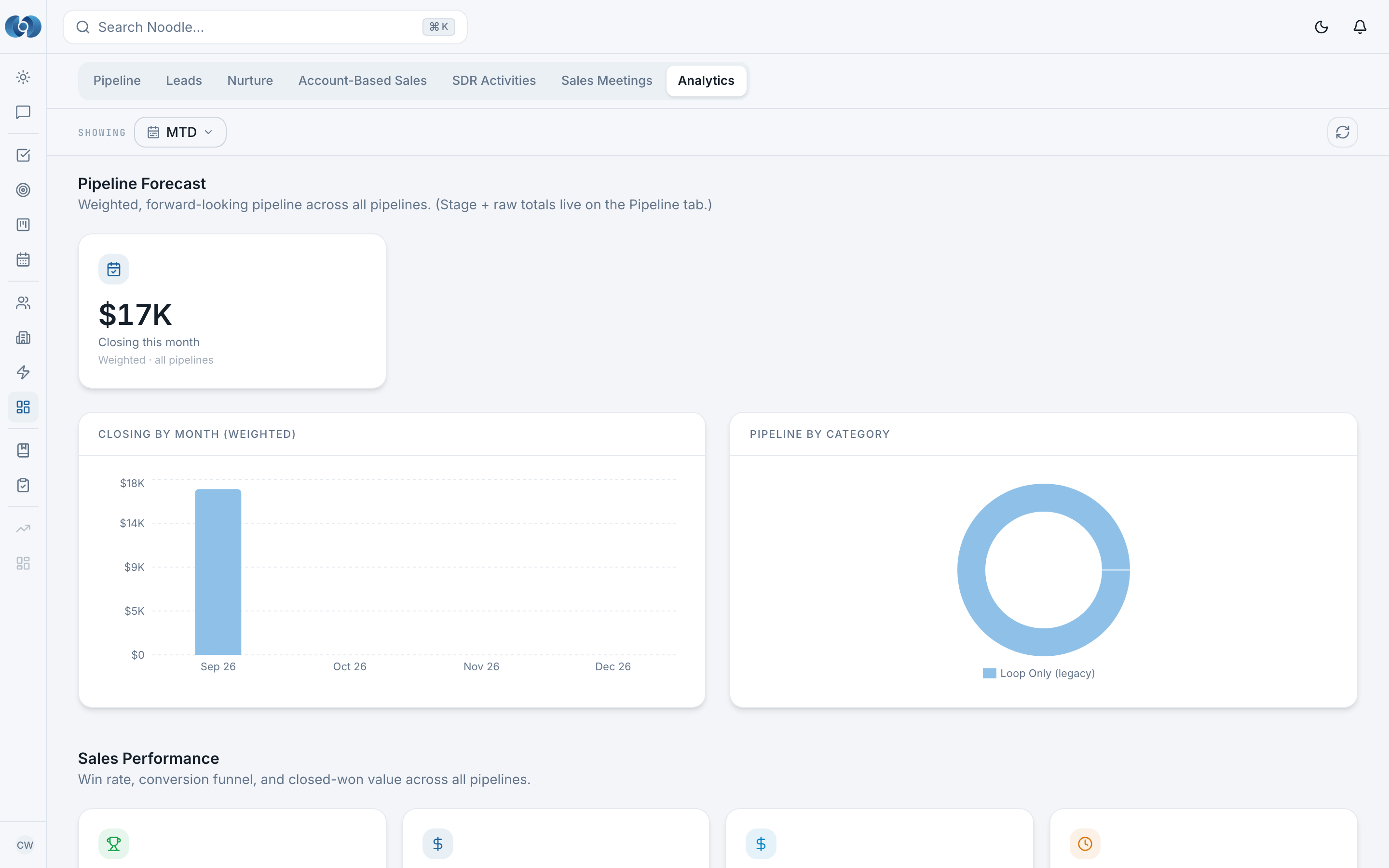
Ask in a sentence and get the figure, the deals carrying it, and the one that matters: the two deals actually dated to close this month are worth $170K on paper and $17K weighted, because both are still sitting at Lead.
Staged, and worth being exact about: unlike the email engine, the chat has no path that runs without a model key, so this conversation was written into the same tables a real one lands in and rendered by the real page. Every number in the answer is true of the pipeline in the screens above it.
The work
The problem
The team paid enterprise per-seat pricing for a CRM shaped like everyone's business but theirs, used about a tenth of it, and kept the real picture in side spreadsheets. Prospecting was manual, pipeline health was assembled by hand, and every tool held a different version of a deal.
What we built
Noodle, first: a lean CRM with a data model matching how Loop sells (deal economics split across the ERP licence, the NetSuite deal and implementation services; lifecycle stages; lead pipelines; call dispositions), pipeline as board and table, contacts and companies with a full activity timeline, tasks with queues, a calendar, and Gmail and Google Calendar sync so every email and meeting lands on the record. Then the systems around it, deliverable by deliverable: an SDR operating system that plans a rep's day in call blocks with a dial queue; a command center with forecast, pipeline by category and sales performance; a lead engine with de-duplication, ICP filtering and a vendor enrichment adapter; an agent runtime with a review queue so nothing an agent produces reaches a customer without a human verdict; email generation on the record; a company brain that indexes calls, notes, emails and the sales playbook; an AI chat module over the whole CRM; and agentic sequences, in build.
Real things it has done
The CRM went from decision to live in weeks and ended the monthly bill for unused seats. A Gmail sync gap around scheduled sends was found and closed with the missed messages recovered, because the sync is watched by an integration-health check rather than trusted. The lead engine checks every new prospect against existing records before spending a credit on it.
- Next.js
- React + TypeScript
- Supabase (Postgres, RLS, auth)
- tRPC
- Tailwind CSS
- Google Workspace APIs
- Claude
The result
Noodle is the sales team's main tool, used every day. The Gmail and calendar sync, the SDR OS and the command center are in production; the agent runtime, email generation, the lead engine and the company brain are built and rolling out; agentic sequences are in build. One stack, added to piece by piece, on one data model.
The systems inside
Delivered systems, connected the way they run.
Screenshots stay with the clients; the shape of the work does not.
- Noodle CRM
- Gmail and calendar sync
- SDR OS
- Command center
- Lead engine and enrichment
- Agent runtime and review queue
- Company brain and AI chat
- Agentic sequences
Noodle CRM
Contacts, companies, deals, leads, tasks and calendar on a data model shaped like how Loop sells. In daily production use.
Gmail and calendar sync
Every email and meeting lands on the record, watched by an integration-health check. In production.
SDR OS
A rep's day planned in call blocks with a dial queue, scoreboard and campaigns. In production.
Command center
Forecast, pipeline by category, sales performance, refreshed on demand. In production.
Lead engine and enrichment
Pulls prospects, drops duplicates, filters to ICP fit, enriches through a vendor adapter. Built, rolling out.
Agent runtime and review queue
Agents run on a schedule; their output waits for a human verdict. Built, rolling out.
Company brain and AI chat
Calls, notes, emails and the playbook indexed; a chat over the whole CRM. Built, rolling out.
Agentic sequences
The sequence itself is the agent: research, draft, send, read the reply. In build.
Evidence at a glance
- custom CRM in daily production use
- generic per-seat tool replaced outright
- every email and meeting synced onto the record
- an SDR's whole day planned in call blocks
- no duplicate lead-lookup spend
- a human verdict on every agent output
From the Systems Library
The reusable patterns behind work like this.
Documented systems from the library in the same territory, each one something we can bring into a project.
- Featured
Workflow
Speed-to-lead pack
A form fill becomes a booked call in under a minute
Works with n8n, Make.
Built and running Agent pack
Post-call brief to CRM
The call ends and the CRM is already done
Works with Claude Code, n8n.
Built and runningAgent pack
Proposal from call notes
A priced proposal in twenty minutes, on your own template
Works with Claude Code, Anthropic API.
Built and running